How Blockchain Applications Are Transforming Multiple Sectors
Introduction: Why blockchain applications matter
Blockchain applications have moved beyond experimental pilots to influence a wide range of industries. Their promise—decentralised record-keeping, tamper-evident ledgers and programmable agreements—addresses persistent business problems such as fraud, provenance and inefficient reconciliation. For policymakers, firms and consumers, understanding these applications is now essential to evaluate risks, opportunities and regulatory options.
Main developments and practical uses
Finance and decentralised finance (DeFi)
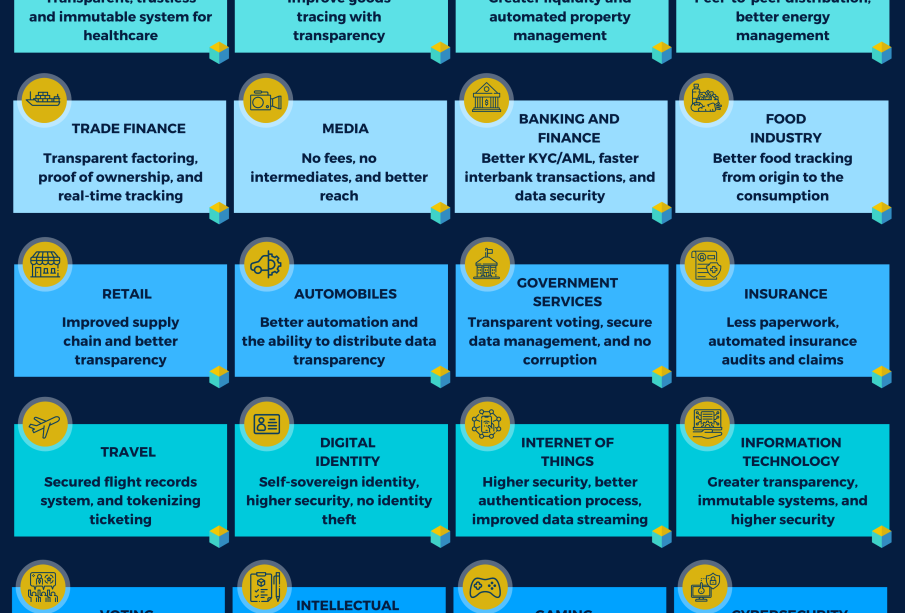
One of the earliest and most visible areas of blockchain application is finance. Public and permissioned chains enable faster settlement, reduced counterparty risk and automated transactions via smart contracts. Traditional banks and fintechs use distributed ledgers for cross-border payments, trade finance and securities settlement, while DeFi platforms offer lending, borrowing and automated market-making without traditional intermediaries.
Supply chains and provenance
Supply-chain applications use blockchain to record provenance, certification and custody events. Immutable timestamps and shared visibility help firms and regulators trace goods from origin to consumer, improving recall response, reducing fraud and supporting sustainability claims such as “ethically sourced” or carbon accounting.
Identity, healthcare and public services
Blockchain is being trialled for digital identity solutions that give individuals greater control over personal data, for secure sharing of medical records and for tamper-resistant land and asset registries. In public services, distributed ledgers can increase transparency in grant distribution, voting piloting and audit trails.
Tokenisation and new business models
Tokenisation converts assets—real estate, art, carbon credits—into digital tokens that can improve liquidity and enable fractional ownership. This can broaden investor access but introduces legal and custody considerations that require careful design.
Challenges and limitations
Despite potential, blockchain applications face obstacles: scalability and energy use for some consensus mechanisms, interoperability between networks, user experience, and evolving regulation. Risk management and clear governance are essential for wider adoption.
Conclusion: Outlook and significance
Blockchain applications are diversifying from niche uses to foundational infrastructure across sectors. In the short to medium term expect incremental adoption—hybrid architectures combining distributed ledgers with existing systems—driven by regulatory clarity and improved technical scalability. For businesses and consumers, the significance lies in greater transparency, new financial models and improved traceability, balanced against operational and legal challenges.