Giant phantom jelly sighting captured by MBARI ROV
Introduction: Why this giant phantom jelly sighting matters
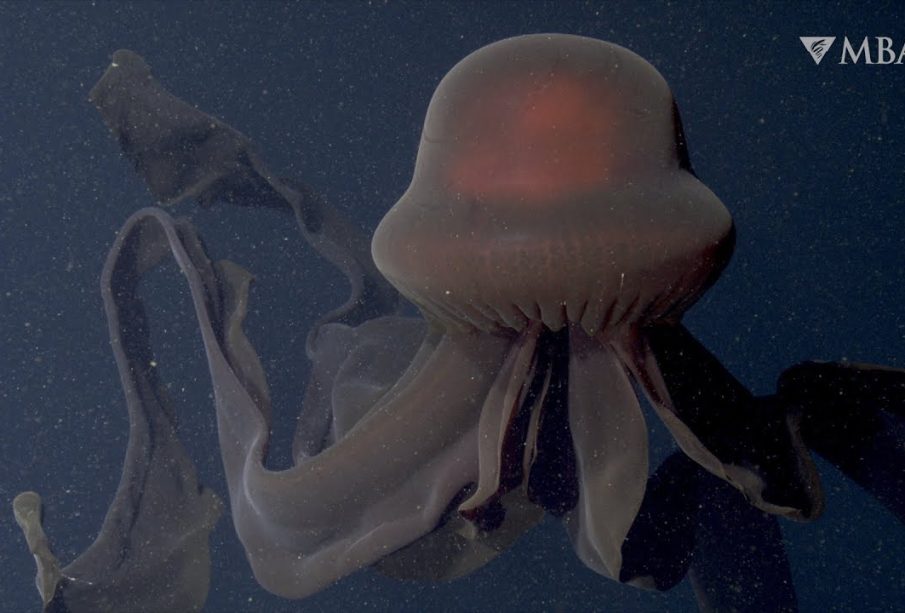
The giant phantom jelly sighting is a rare and striking example of how modern technology is revealing life in the ocean’s midnight zone. Observations of large, gelatinous animals such as Stygiomedusa gigantea are important because they expand our knowledge of deep‑sea biodiversity and the behaviours of species that have long eluded scientists. Recent video footage from remotely operated vehicles (ROVs) has made such encounters visible to researchers and the public, demonstrating the relevance of continued deep‑sea exploration.
Main body: Details of the sightings and scientific context
Monterey Bay encounter
In November 2021, researchers from the Monterey Bay Aquarium Research Institute (MBARI) used the ROV Doc Ricketts to record a giant phantom jelly at a depth of about 990 metres (3,200 feet) in Monterey Bay. The footage shows a bell more than one metre (3.3 feet) across and four ribbon‑like oral arms that can exceed 10 metres (33 feet) in length. Such high‑definition video — and increasingly 4K resolution — allows scientists to study the animal intact in its natural setting, capturing details of appearance and behaviour that would be lost if the jelly were collected in a trawl.
Rarity and distribution
Although the species was first collected in 1899, scientists have only encountered Stygiomedusa gigantea about 100 times overall. MBARI’s ROVs alone have logged thousands of dives but have seen this spectacular species only nine times, underscoring the challenge of observing deep‑water life. Records indicate the giant phantom jelly has a worldwide distribution and has been observed in all ocean basins except the Arctic, but the difficulty of accessing its deep habitat contributes to the relative scarcity of confirmed sightings.
Other recent discoveries
Separate deep‑sea expeditions have also reported rare sightings, including a striking giant phantom jelly recorded off the coast of Argentina. Together, these encounters reinforce that the deep ocean still holds many uncommon and poorly understood species.
Conclusion: Significance and outlook
These giant phantom jelly sightings highlight the value of ROVs and high‑resolution imaging for advancing deep‑sea science. As ROV surveys continue and video technology improves, researchers expect more intact observations that will refine knowledge of distribution, biology and ecological roles of gelatinous deep‑sea species. For readers, such footage is a reminder of the vast, mostly unseen diversity beneath the waves and the importance of supporting exploration that can inform conservation and science.

