Deloitte Football Money League: Record €11.2bn in 2023/24
Introduction: Why the Deloitte Football Money League matters
The Deloitte Football Money League is a leading annual analysis of club revenues and financial trends in world football. Now in its 28th edition, the report is a key barometer for investors, rights holders and fans because it quantifies how matchday, broadcast and commercial activity combine to support clubs’ operations. The 2025 report highlights notable shifts in income composition and a record aggregate figure for the top 20 clubs, underlining the economic scale of elite football in 2023/24.
Main body: Key findings from the 2025 report
Record aggregate revenue and growth
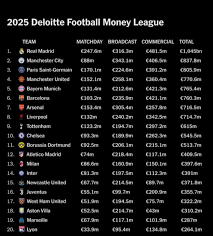
Deloitte reports that the world’s top 20 revenue-generating clubs produced a combined €11.2 billion in the 2023/24 season, a 6% increase on 2022/23. The rise was driven by record matchday, commercial and broadcast revenues across the Money League cohort.
Breakdown of income streams
Commercial revenue accounted for the largest share of total earnings, reaching €4.9 billion for the Money League clubs. Broadcast revenue remained a major income stream as well, amounting to €4.2 billion in 2023/24. The report highlights a clear divide within the top 20: for clubs ranked inside the top 10, commercial activities such as sponsorship and merchandise made up 48% of total revenue, while clubs ranked 11th to 20th relied more heavily on broadcasting, which represented 47% of their earnings.
Club-level and retail trends
At the individual-club level, Real Madrid became the first football club to generate over €1 billion in revenue during the 2023/24 season and sits at the top of the 2025 Money League. Deloitte also notes that eight Money League clubs reported stronger retail performance, a sign of clubs leveraging brand value and sporting success to capture more of the merchandising value chain.
Conclusion: Implications and outlook
The 2025 Deloitte Football Money League underscores continued commercialisation and the resilience of broadcast income for many clubs. The record €11.2 billion total and the emergence of stronger retail performance suggest a business model increasingly focused on direct-to-consumer sales and brand monetisation. For stakeholders, the findings point to growing opportunities — and competitive pressure — as clubs seek new revenue streams while maintaining sporting performance. Observers should watch whether clubs can sustain commercial growth and whether retail and direct sales reshape revenue mixes in coming seasons.


