Understanding fpl price changes: timing, causes and examples
Introduction
FPL price changes matter to managers because even small movements can affect transfer strategies, team value and chip decisions. Understanding how and when prices shift helps managers plan transfers, protect team value and anticipate transfer-market churn. This story explains the mechanics behind fpl price changes, what predictors show, and recent examples to illustrate the uncertainties managers face.
Main body
How price changes are triggered
In principle, price changes are driven by the balance of transfers in and out for a player. Public guidance and community reporting note that changes are applied once per day, typically around 1am UK time. Changes move in increments of £0.1, and community sources indicate a single player cannot increase or decrease by more than £0.3 in that update. Price falls require net transfers out to be below a threshold relative to a player’s ownership to trigger a reduction.
Predictors and practical limitations
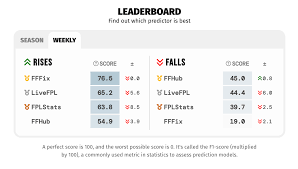
Because the exact FPL price-change algorithm is not fully transparent, third-party predictors must make judgement calls. Predictors decide a probability that each published transfer is counted towards the net transfer figures that cause price movement. Tools such as LiveFPL offer a Price Predictor with metrics including live rank, leagues, price-change probabilities and transfer-planning stats. The service uses signals like +100% to indicate a predicted rise and -100% to indicate a predicted fall. A sample LiveFPL entry shows a player listed (Adli, MID) at £5.4 with ownership figures shown around 60.97%–61.07% and a small predicted movement (+0.02%) from a sample data set of 697 records — illustrating how granular signals can be.
Recent examples and anomalies
Recent reporting highlights practical oddities: Fantasy Football Fix noted O’Reilly rising to £5.1 despite an injury concern, while Bowen fell to £7.5 amid poor form; Maguire and Le Fée were among players registering rises. Conversely, Dominic Solanke experienced heavy transfers out but avoided an immediate price fall for several days — a pattern that seemed inconsistent with algorithm-driven expectations and underlines the opacity of the exact counting rules.
Conclusion
For FPL managers the takeaway is to treat price predictors as a planning tool rather than a guarantee. Nightly updates, small incremental moves and opaque counting rules mean monitoring ownership, transfer flows and third‑party predictors is essential. Expect occasional anomalies like delayed falls or rises despite injuries; use predictor signals alongside your own transfer strategy to manage team value and timing effectively.





